


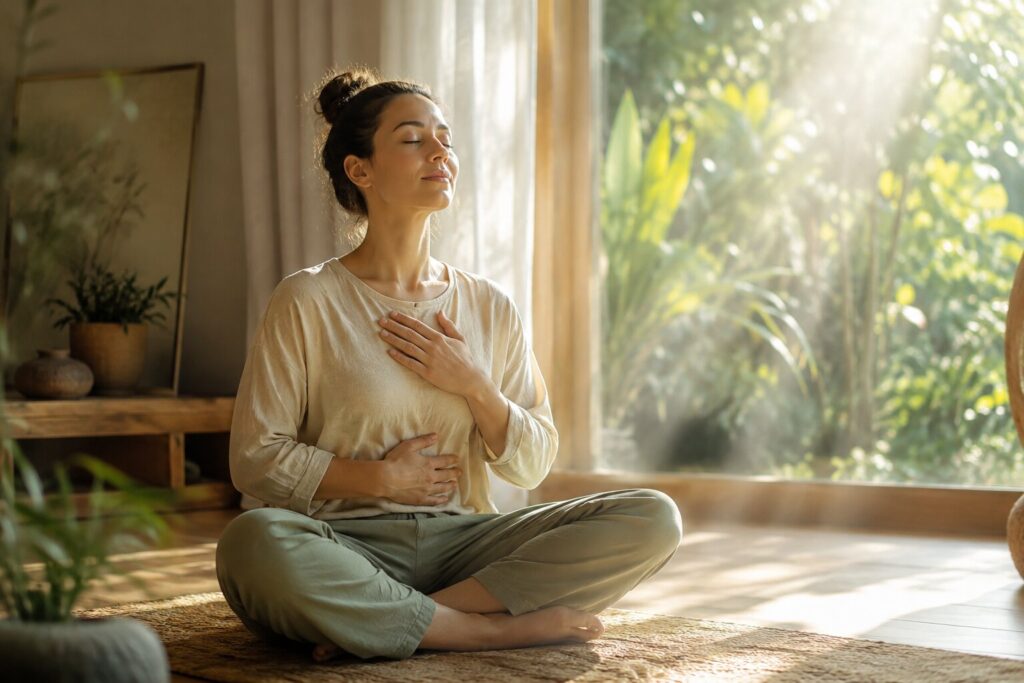
You're sitting there, your thoughts keep racing, no matter how hard you try to shut them off. At that very moment, you can't think anymore, but you can breathe. That's where breath meditation comes in.
The most important facts in brief:
Breath meditation originates from a Buddhist tradition known as anapanasati, which refers to the conscious awareness of the inhalation and exhalation. Unlike many mindfulness exercises, you don’t need a mantra, an image, or your imagination. Just your breath, which is already there anyway.
That's what makes this method so accessible. You don't have to create anything. You just have to observe what's already happening.
In practice, you sit upright, close your eyes, and focus your attention on the spot where you feel your breath most clearly. Usually, this is your nose, chest, or abdomen. You don't change anything. You just observe.
Most people try to resolve stress in their minds. They talk themselves into staying calm, analyze the problem, and search for the next thought that will make everything better. The problem with this is that stress isn't a mistake in thinking—it's a physical reaction.
Your nervous system doesn't distinguish between a real danger and a full inbox. It reacts the same way in both cases: with increased tension, shallow breathing, and an activated sympathetic nervous system.
Breathing is the only part of your nervous system that can be controlled both unconsciously and consciously. That’s exactly what makes it the most direct tool you have. You can’t consciously slow down your heart. You can’t consciously calm your digestion. But you can change your breathing, and through the vagus nerve, that has a direct effect on both.
Researchers at Harvard Medical School explain that slow, conscious breathing activates the parasympathetic nervous system, thereby lowering heart rate and stress hormone levels. This is not some esoteric claim, but a measurable physiological mechanism.
Anyone who is constantly struggling with their own inner restlessness will find in the The Path to Inner Peace a good next step.
You don't need an app, any equipment, or a specific location. Just follow these steps:
Five minutes is enough to get started. Consistency is more important than duration. Practicing daily for two weeks is more beneficial than a single 30-minute session.
A common mistake: trying to breathe "correctly." Breath meditation is not a performance. As soon as you start controlling your breath, you are no longer in observant meditation but in active breathwork, which is a different practice with a different goal.
For anyone who isn't yet consciously aware of their abdominal breathing, it's worth taking a look at Diaphragmatic Breathing and Its Role in the Nervous System.
At some point, many people realize that simply observing their breath helps them become calmer, but the actual cause of their restlessness remains unaddressed. Their mind becomes quieter, yet the tension, the blockage, and the old pattern remain deeply embedded in the body.
Observational breathing calms the nervous system. Creative breathing can release what lies beneath.
This is exactly where active breathwork comes in—a form of breathwork that not only observes the breath but also uses it in a targeted way to access deeper-seated emotions and blockages. Eva Kaczor, creator of the PSYCHEDELIC BREATH® method, describes breathing as a direct pathway to states of consciousness that go beyond mere relaxation, leading to genuine inner transformation.
If you notice that you’re becoming calmer but not truly freer, that’s a sign to go deeper. The free "Vision & Breathwork" masterclass with Eva Kaczor shows you how targeted breathwork can take you to places where pure observation can’t reach.
Sign up for the free "Vision & Breathwork" masterclass →
A 2023 study by Stanford University directly compared various breathing techniques with traditional mindfulness meditation. The result: targeted breathing exercises reduced participants’ stress levels more effectively than meditation alone without a focus on breathing.
That doesn't mean meditation is ineffective. It means that using the breath as an anchor provides a measurable benefit compared to techniques that work only on a mental level.
Those who already practice mindfulness in their daily lives often find that combining it with a focus on breathing is the missing piece.
Both forms have their place, but they serve different purposes:
If you don't know where your inner restlessness actually comes from, you can find out through Recognizing and Changing Beliefs often the deeper level underlying the symptoms.
Is breath meditation the same as breathwork? No. Breath meditation involves observing the breath without altering it. Breathwork actively controls the breath to specifically influence the body and mind.
How long does it take for breathing meditation to take effect? The first noticeable effects on relaxation often become apparent after just the first session. Lasting changes in stress levels require regular practice over several weeks.
Can breathing meditation reduce anxiety? Yes, by activating the parasympathetic nervous system, it directly affects the body's stress response, which often underlies anxiety.
Breath meditation requires no preparation, no prior knowledge, and no special talent. It only requires a willingness to observe for a few minutes what your body has been doing all along. If you find that mere observation isn’t enough, active breathwork is the next logical step—not as a substitute, but as a way to deepen your practice.
Fang jetzt an: Setz dich hin, schließe die Augen und zähl fünf bewusste Atemzüge. Nicht mehr. Das reicht, um zu spüren, was passiert, wenn du hinschaust statt wegzudenken.


