



You're sitting on the couch in the evening; the day is over, but your body hasn't caught up yet. Your heart rate is high, your shoulders are tense, and that email from 5:40 p.m. is playing on a loop in your head. You know you should wind down. Your nervous system has other ideas.
There's a lever for exactly that, which you can operate in two minutes: your Breath. If you want to stimulate the vagus nerve, you don't need a device or an hour of your time.
The most important facts in brief
Stimulating the vagus nerve means specifically activating the vagus nerve—the tenth cranial nerve—so that the parasympathetic nervous system takes control and the heart rate, breathing, and digestion shift into rest mode.
According to NDR Visite (2026) the largest cranial nerve and the most important communication channel between the body and the brain. It runs from the brainstem through the neck and chest to the abdominal cavity and connects, among other things, the heart, lungs, and intestines to the brain.
Your autonomic nervous system has two opposing systems. The sympathetic nervous system prepares you for fight or flight: it increases your heart rate, tenses your muscles, and shuts down digestion. The parasympathetic nervous system controls the opposite—that is, rest, digestion, and regeneration. The vagus nerve is its most important nerve.
The problem is rarely the stress itself. The problem is that the switch back to a state of calm no longer flips reliably. Anyone who is constantly in alarm mode will eventually feel Emotionally drained, sleeps less well, and gets irritated by little things.
Stress doesn't go away just because you try to think it away; it goes away when your nervous system receives the signal that the danger has passed.
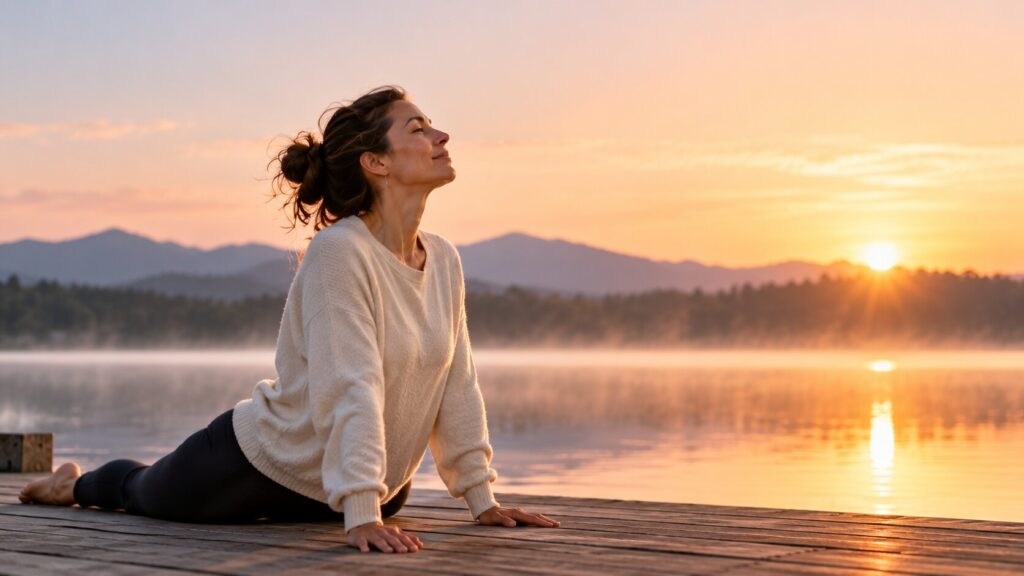
The quickest way to calm your vagus nerve is to breathe in calmly through your nose and breathe out for longer than you breathe in. Strictly speaking, you aren't calming it—you're activating it so that it can calm you down.
The reason lies in a mechanism that every physiologist is familiar with: When you inhale, your heart rate rises slightly; when you exhale, it drops. This interplay is called respiratory sinus arrhythmia, and the decrease during exhalation is mediated by the vagus nerve. The longer and more calmly you exhale, the more influence the parasympathetic nervous system has.
The variation in your heartbeat is called heart rate variability, or HRV for short. A high HRV is considered a sign that your nervous system can flexibly switch between stress and relaxation. In HRV research, slow breathing—at a rate of about six breaths per minute—is therefore often studied as a form of exercise.
Breathing is the bodily function that occurs automatically yet can also be controlled at will, and is therefore your most direct link to the autonomic nervous system.
That's what sets it apart from everything else on the list. You can't control your heart rate, and you can't control your digestion either. But you can control your breathing.
Anyone who has been trying for a long time to, Control emotions, ...by pushing them out of his mind, he knows the limits of this approach. The mind loses out to a body in alarm mode. Breathing reverses the order: first the body calms down, then the mind follows. How this leads to genuine inner peace How well you develop this skill depends on how regularly you practice it.
All three exercises follow the same principle: The exhalation is longer than—or at least as long as—the inhalation. Sit up straight, place one hand on your stomach, and breathe in through your nose.
1. Prolonged exhalation (the foundation)
Extended exhalation is the simplest way to activate the vagus nerve because it emphasizes the exhalation, during which your heart rate slows.
2. Coordinated breathing: Inhale for 5 seconds, exhale for 5 seconds
Coherent breathing results in exactly six breaths per minute, which corresponds to the rhythm frequently studied in HRV research. It is ideal for the moment before a difficult conversation or presentation.
3. 4-7-8 for the Evening
In this exercise, the exhalation is twice as long as the inhalation. That makes this variation the best choice if you have trouble winding down in the evening.
If you feel dizzy during the exercises, return to normal breathing and shorten the count. If you are pregnant, have asthma, a cardiovascular condition, or are experiencing mental health issues, talk to your doctor first.
Three minutes is enough to get started. More important than the duration is that you incorporate the exercise into the parts of your day when stress arises: before your next meeting, in the car, after work.
In addition to breathing, self-help guides usually recommend splashing cold water on your face, humming or singing, neck massages, and Meditation. BlackRoll lists breathing exercises, cold water, and meditation as typical ways to stimulate vagus nerve activity.
These methods are useful additions, but they vary in effectiveness. A cold shower or a cold washcloth on your face provides a strong stimulus that jolts you awake for a short time. Humming almost automatically lengthens your exhalation and therefore has a similar effect to the exercises above. Meditation primarily trains you to notice tension sooner.
A 2022 study by the University Hospital of Tübingen shows what happens in the lab when the vagus nerve is directly stimulated: Researchers noninvasively stimulated the vagus nerve in the ear of 31 participants. Within a few minutes, the connection between signals from the stomach and the brain strengthened, particularly in the brainstem (Tübingen University Hospital, 2022). The press release describes this as basic research; it mentions therapeutic applications only as possible future options.
It has been demonstrated in laboratory studies that the vagus nerve can be influenced; however, the effectiveness of individual home remedies has been documented to varying degrees, and none of them can replace a medical evaluation in cases of cardiac arrhythmia, persistent fatigue, or anxiety symptoms.
So if you want to slow down your pace in general, start with what has the most immediate effect and costs the least: your breath. Deceleration begins in the first few minutes of the day, not during annual leave.

The exercises above work. And yet many people are familiar with this phenomenon: Things calm down for the moment, but the next morning, the tension is back.
In that case, the issue often runs a little deeper. It’s the pressure you’ve been masking with your performance for years—and it’s not something you can just breathe away in three minutes.
Calming breathing exercises regulate the nervous system in the moment, whereas breathwork addresses the underlying causes of your chronic stress.
Breathwork means working with your breath: You consciously change your breathing to influence your body and your perception. The range of techniques is wide. Calm forms, such as coherent breathing, have a soothing effect. Dynamic forms, such as connected breathing, which Wim Hof breathing or the Holotropic Breathing are, on the other hand, considered energizing; they are practiced while lying down and under guidance, and holotropic breathing is the subject of professional debate. That is precisely why dynamic forms do not belong in a self-experiment between two meetings.
Eva Kaczor, founder of PSYCHEDELIC BREATH®, combines dynamic breathing with music in her method. Her journey—which she herself calls „from pain to purpose“—led her to breathwork, and today she trains breathwork teachers. The vagus nerve is a separate topic in her training program: According to the program page, Module 2 of the Psychedelic Breath School is dedicated to stimulating the vagus nerve for rapid relaxation. The program page does not cite any scientific studies on the method’s effectiveness. Nevertheless, it serves as a path of exploration for people who want to go deeper.
At Greator, we work every day with people who are functioning but still can’t find peace. For them, breathwork is rarely the entire solution, but it’s almost always the starting point. Anyone interested in training to become a breathwork teacher can find the key details on the page Breathwork Training.
If you notice that the tension doesn't completely go away even after the exercise, it's not a matter of more discipline, but of taking a different approach. In the „Vision & Breathwork“ Masterclass with Eva Kaczor You'll experience how breathwork takes you from simple relaxation to greater inner clarity, and why calmness can become a source of direction.
Stimulating the vagus nerve isn't a biohack, nor is it a matter of equipment. It's the decision to give your nervous system the signal it's waiting for: You're safe; you can relax.
You don't have to wait for the stress to go away on its own. Your breath is always there—in every meeting, in every car, on every sofa. And when you realize there's more to it than just a stressful day, breathwork is a way to take a closer look.
Now sit up straight, place one hand on your stomach, and exhale slowly four times in a row, making each exhalation longer than your inhalation. Just four times. That's enough.